If you've worked on a building site, you've been handed a SWMS to read and sign. But many sole traders and small trade businesses aren't sure exactly when they need their own, what has to go in it, or whether the generic template they bought online is good enough.
This guide explains what a safe work method statement (SWMS) is, when the law requires one, what it should include, and how to keep it useful rather than a box-ticking exercise. It's general information for trades in Australia, current as at November 2026.
What a SWMS is
Safe Work Australia's page on high risk construction work requiring a SWMS describes a SWMS as a document that sets out:
- the high risk construction work activities,
- the hazards that could arise from those activities, and
- how the business will control the risks.
It's a practical, site-level plan for the dangerous parts of a job, written so the people doing the work can follow it.
Why it matters
Construction is one of Australia's most dangerous industries. Safe Work Australia's Key Work Health and Safety Statistics 2026 reports that 41 construction workers died from traumatic work injuries in 2025, almost one in five worker fatalities nationally. Across all industries, falls from a height caused 28 deaths and being hit by falling objects caused 21, and Safe Work Australia notes both are commonly associated with construction work.
Construction worker fatalities in Australia, 2023 to 2025
41 construction workers died from traumatic work injuries in 2025, up from 35 in 2024. Construction accounted for almost 1 in 5 worker fatalities.
Show the figures as a table
| Year | Construction worker fatalities |
|---|---|
| 2023 | 46 |
| 2024 | 35 |
| 2025 | 41 |
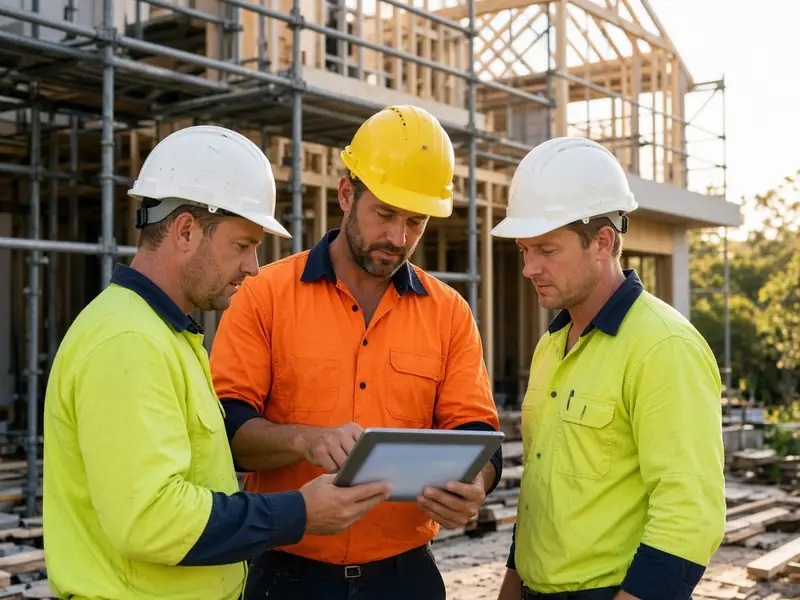
A good SWMS makes everyone stop and think about the riskiest parts of the job before they start.
When you need a SWMS
You need a SWMS before you start any high risk construction work (HRCW). There are 19 types, and they cover a lot of everyday trade work: anything with a risk of falling more than 2 metres, work near energised electrical services, work where mobile plant is moving, trenches deeper than 1.5 metres, and work that may disturb asbestos, among others.
The 19 types of high risk construction work that need a SWMS
If your work falls into any of these, you need a SWMS before you start.
| High risk construction work | |
|---|---|
| 1 | Risk of a person falling more than 2 metres |
| 2 | Work on a telecommunication tower |
| 3 | Demolition of a load-bearing element of a structure |
| 4 | Demolition of an element related to the physical integrity of a structure |
| 5 | Work that involves, or is likely to involve, disturbing asbestos |
| 6 | Structural alteration or repair that needs temporary support to prevent collapse |
| 7 | Work in or near a confined space |
| 8 | Work in or near a shaft or trench deeper than 1.5 metres, or a tunnel |
| 9 | Use of explosives |
| 10 | Work on or near pressurised gas mains or piping |
| 11 | Work on or near chemical, fuel or refrigerant lines |
| 12 | Work on or near energised electrical installations or services |
| 13 | Work in an area that may have a contaminated or flammable atmosphere |
| 14 | Tilt-up or precast concrete |
| 15 | Work on, in or next to a road, railway, shipping lane or other traffic corridor in use |
| 16 | Work where there is any movement of powered mobile plant |
| 17 | Work in areas with artificial extremes of temperature |
| 18 | Work in or near water or other liquid with a risk of drowning |
| 19 | Diving work |
Under the model WHS laws, which apply in every state and territory except Victoria, the duty sits with the business (the person conducting a business or undertaking, or PCBU) carrying out the high risk construction work. Safe Work Australia says that business must prepare, keep, comply with and review a SWMS, and give a copy to the principal contractor.
In Victoria, the Occupational Health and Safety Regulations 2017 require employers and self-employed persons to prepare a SWMS before starting HRCW. WorkSafe Victoria says the work must be done in accordance with the SWMS, and a copy kept for the duration of the work.
A SWMS is only required for high risk construction work, but you still have to manage every other risk on the job. Many businesses use a job hazard analysis or a site risk assessment for lower-risk work.
What goes in a SWMS
Safe Work Australia's interactive SWMS tool walks through preparing, using and reviewing a SWMS. A good one generally includes:
- The job details: the site, the principal contractor, the work being done and who's doing it.
- Which high risk construction work it covers, from the list of 19.
- The steps of the task, in order.
- The hazards and risks at each step.
- The control measures, described clearly enough that a worker knows exactly what to do. WorkSafe Victoria warns against vague wording.
- How the controls will be put in place, monitored and reviewed.
- Sign-off: the workers who've been consulted and have read it.
Use the hierarchy of control
Controls should follow the hierarchy of control: eliminate the risk if you can, then substitute, isolate or use engineering controls, then administrative controls, and personal protective equipment last. For example, for work at height, working from the ground or using scaffolding with edge protection comes before relying on a harness.
Make it site-specific
A generic template is a starting point, not a finished SWMS. WorkSafe Victoria suggests reviewing the proposed work and any site-specific factors that could affect it. Before each job, check the access, the weather, overhead powerlines, other trades working nearby, and anything else particular to that site, and update the SWMS to suit. Hand-written changes on site are fine, as long as everyone is told about them.
SWMS, JHA and risk assessments: what's the difference?
The names get used loosely on site, so it helps to be clear.
- SWMS: required by law before high risk construction work. It covers the high risk activities, their hazards and the controls.
- Job hazard analysis (JHA), also called a job safety analysis (JSA): a step-by-step look at the hazards in any task, high risk or not. Many builders ask for one for everyday work.
- Risk assessment: the broader process of identifying hazards, assessing how likely and how serious the harm could be, and deciding on controls.
You can combine them, as long as the high risk construction work is clearly covered in a SWMS and the document stays easy to follow. A 30-page document nobody reads is less safe than two clear pages people actually use.
Using it on site
A SWMS only works if people follow it.
- Go through it with the crew before work starts, in plain language, and get them to sign.
- Keep it on site where everyone can get to it.
- Stop if it isn't being followed. WorkSafe Victoria says that if the SWMS isn't complied with, the work must stop as soon as it's safe, and can't resume until it complies or the SWMS has been reviewed.
- Review it when things change, for example when the method changes, a control doesn't work, or there's an incident.
Apprentices and new workers need extra attention. Check they understand it, not just that they've signed. Our guide to hiring your first apprentice covers supervision.
Working for a builder
If you're a subcontractor, the principal contractor will usually ask for your SWMS before you start. Under the model WHS laws, you must give them a copy, and they have duties to make sure the SWMS is in place and followed. Many builders also ask for your insurance certificates and licences at the same time. See our guides to public liability insurance and trade licences by state.
Having your SWMS ready, up to date and easy to share makes you easier to work with, and builders notice.
Common mistakes
- Using one generic SWMS for every job, without checking the site.
- Listing PPE as the only control when better options exist higher up the hierarchy.
- Writing it and filing it. A SWMS sitting in the ute doesn't protect anyone.
- Not updating it after an incident or a change in method.
- Getting signatures without explaining it. Workers need to understand the controls.
- Leaving out workers' input. The people doing the work often know the risks best, and you're required to consult them.
Where to get help
- Safe Work Australia for the interactive SWMS tool and the model Code of Practice for construction work.
- Your state or territory WHS regulator for local guidance. In Victoria, that's WorkSafe Victoria.
- Your industry association for trade-specific templates.
SWMS on your phone
Paper SWMS get lost, rained on and left in the ute. Tradie Business includes safety forms: SWMS starters, job hazard analysis forms, risk ratings, crew sign-off on their phones, sharing with builders, versions and review dates, plus incident reports. Read more on our SWMS software page, or see pricing. It's built for Australian trades from electricians to scaffolders and roofers, with a 30-day free trial.
If something does go wrong, check your obligations under your state's workers compensation scheme. See our guide to workers compensation by state.